Lukas OberbichlerSoftware engineer & product builder

I turn messy workflows into reliable software.
I build software and AI tools from the first conversation to delivery — as part of your team or as an independent contractor.
- For employers
- Vehicle software at Bosch, museum installations at Inomedia and planning plug-ins at Build Informed.See my experience
- For businesses
- I replace copying between spreadsheets and inboxes with software built around how your team works.See the Letter demo
Open to roles and contract projectsRemote, with occasional agreed on‑site collaboration if requested
Main project · in development
Letter
Try an example of your workflow.
Letter is the main product I’m building. Describe how your business works, answer a few questions and try an editable example for enquiries, production or invoicing.
Letter · Enquiry follow-up
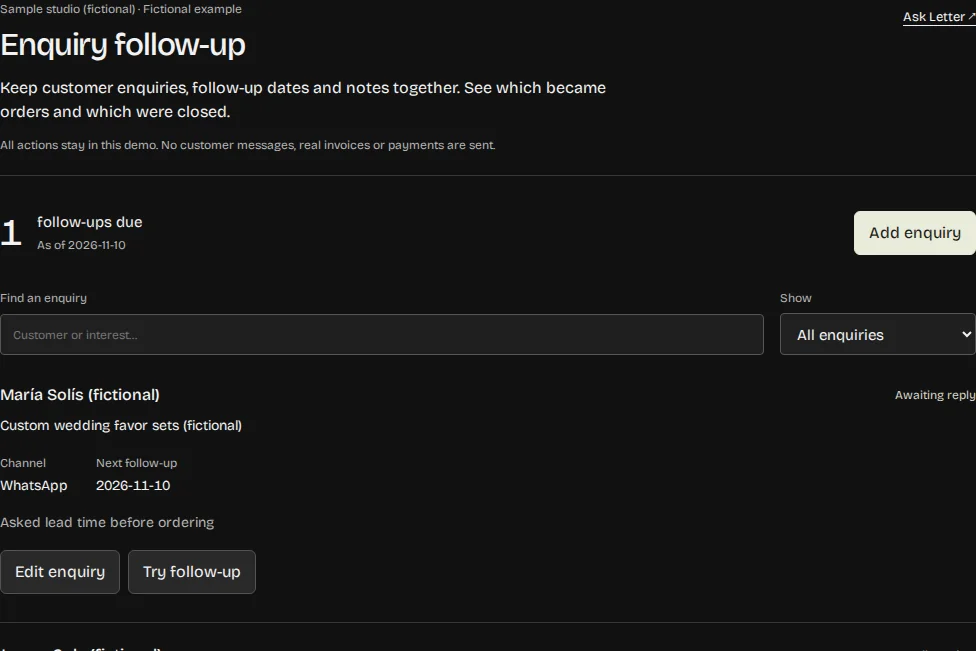
Screenshot of the Letter demo · sample dataView full-size screenshot
Four checks before a change goes live
- The goal is written down first
- Built in a separate copy
- Reviewed independently
- Checked against the live version
How I keep Letter reliableTechnical details, the approach behind them and what is still in development.
An approach inspired by the AI Engineering Loop
I’m following the AI Engineering Loop described by Langfuse and others: applications that agents can inspect, evaluate, experiment with and improve. Human feedback defines what “better” means.
How Letter ships changes safely
Agents do much of the building on Letter. Four checks keep every change reviewable and the working version safe.
- ScopedAgree what “done” means
The problem, the result we want and how we’ll check it are written down first.
- IsolatedBuild beside the working version
Changes happen in a separate copy, so the version people use keeps working.
- ReviewedA second, independent review
A separate reviewer checks that exact change and reports any problems.
- VerifiedReleased only with evidence
Release checks tie the reviewed code to what is actually running live.
Pieces I’ve implemented
- Observable behavior
- Trace export, scores and authenticated readback provide evidence that can be inspected by people and agents.
- Explicit change boundaries
- Revision-bound briefs, isolated candidates and bounded review-and-repair cycles keep a requested change inspectable.
- Checks tied to the result
- Release qualification connects the candidate’s source to browser checks and matching observations. Incompatible changes can be held for review.
The AI Engineering Loop
Live activity reveals what needs work. Development turns those observations into tested changes, then deployment starts the next cycle.
- TraceOnline
Capture what the application does in real use.
- MonitorOnline
Find patterns and problems; add human feedback.
- Build datasetsOffline
Turn useful examples into repeatable test cases.
- ExperimentOffline
Try changes to prompts, models and code.
- EvaluateOffline
Compare results against defined quality criteria.
These are implemented building blocks. The broader dataset, experimentation and evaluation workflow is still being developed.
The Langfuse approachFrom car software to AI tools
At Bosch, in museums and in construction software, I’ve worked on the details that turn code into something people can use. Years of direct customer work, including IT support for seniors, taught me to listen carefully and explain technical choices clearly.
Earlier work
Full history on LinkedIn- Bosch
- Developed vehicle control software and tested how it behaved in prototype vehicles and simulators.
- Inomedia
- Took over an existing museum application, built Linux video kiosks and installed them on site through to handover.
- Build Informed
- Built plug-ins for Revit, the building-design software, to automate planning work and bring older code up to date.
- Tribe
- Co-founded a creator-funding product and helped build a music-licensing prototype presented at Red Bull’s London offices. Read the organiser’s account
What I can help with
Automate repetitive work
Keep enquiries, orders and sales in one place instead of retyping them.
See an example in LetterBuild an AI feature
Add AI that drafts or sorts, with a person approving the result.
See the newsletter botImprove an existing app
Take over, update and connect the software you already rely on.
See my earlier work
How a project starts
For employers: The same first step works for roles — or send me the job description. Email about a role
A 15-minute call
You describe the workflow or the role. We find out quickly whether I’m the right fit.
A short written plan
What I’d build first, what it needs from your side and what stays out of scope.
Built in small steps
You see progress early and can steer it before anything is final.
Let’s work together
Tell me about the role or the workflow you want to improve. Fifteen minutes is enough to see whether we’re a fit.
Book a 15-minute callOpens Calendly — pick any open slot.
Or write to lukas@
- Email about a role Tell me about the team and the role.
- Email about a project Tell me about the workflow you want to improve.
Rates, budget, start date and working-hour overlap: we’ll cover them on the call.